
Destroy Writer's Block
All you need is pen, paper, and Philip K. Dick

Reclaiming Your Authentic Voice (The Philip K. Dick Way)
Philip K. Dick never trusted reality.
In his work, he questioned our shared reality, bent it, rewired it.
To him, the world was a projection.
A simulation stitched together by invisible systems and corporate hallucinations.
But beneath the paranoia, there was something more human:
a desperate need to find what was real inside the noise.
That’s the same mission every creator faces.
Especially now, when algorithms whisper what’s trending, and every artist is tempted to conform for visibility.
We are born into a world of multiple realities.
Some are built for us by others.
Family, culture, the education system, industry.
But the truest reality is the one you construct from your own experiences, memories, and myth.
That’s what Dick did with every story he wrote.
He wrote from the fracture.
From the uncertainty of being human in a machine world.
From the paranoia of feeling your voice replaced by something synthetic.
And yet, that paranoia became his art.
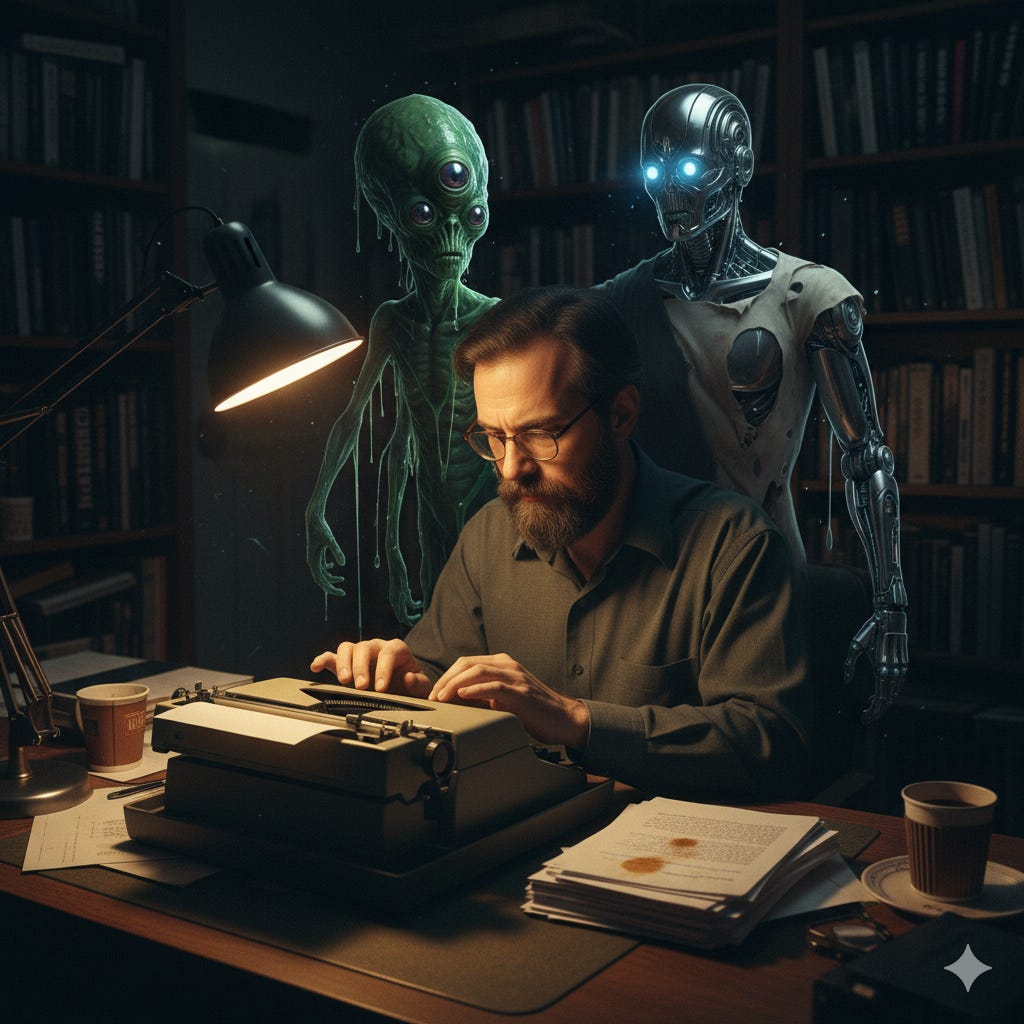
The androids, precogs, and counterfeit humans in his short stories and novels were reflections of his own fear of losing selfhood.
Of being overwritten by the collective program.
That’s what happens when you lose your authentic voice.
When you start writing to please an audience, or mimic a trend, or smooth your rough edges to fit a brand.
You become a replicant of yourself.
A copy of a copy.
Degraded quality.
To reclaim your voice is to rebel against the simulation.
To choose perception over programming.
To tell yourself: I will write the world as I see it, not as I’m told it is.
But that’s not a clean or comfortable process.
When you begin to speak in your true voice, fear will appear.
Not the abstract anxiety that buzzes in the background.
This fear has texture. It’s physical, almost sentient.
In my earlier post, How to Smash Writer’s Block, I described fear as a ghostly thing that lives beside your creative process.
When you see it, and give it form, it stops being a fog and becomes a doorway to gained creative power and self empowerment.
Philip K. Dick faced that same creature every time he wrote.
As do we.
But where he turn scrolling for “research” Philip invited the fear into his writing space.
He turned fear into fiction, doubt into alternate dimensions.
Every hallucination became a metaphor for the artist’s mind trying to find truth in a world that constantly edits itself.
That’s the trick.
Your fear is proof that the voice trying to emerge is real.
If it weren’t, the system wouldn’t resist it.
Writing, like Dick’s worlds, is an experiment in shifting your perception to what you want things to be.
You start to see that every idea, every draft, every imperfect page is part of a deeper inquiry:
Who is the one writing this?
The more you chase that question, the clearer your voice becomes.
Not because you discover an answer, but because you commit to the search.
Dick’s genius wasn’t in predicting the future.
It was in documenting the collapse of illusion.
He peeled away the artificial layers until only the trembling, human pulse was left.
That’s what reclaiming your voice looks like.
Not perfection.
Just radical honesty.
You don’t escape the simulation by running from it.
You break it from the inside.
Line by line, scene by scene, truth by truth.
And when you finally hear your voice, unfiltered, unborrowed, unmistakably yours.
you will know:
you’ve woken up.
Love this!! So true—the most powerful rebellion is to own your story and trust your voice!
Thank you for the advice! Writing personal fears into a story can make them more powerful because readers who share those fears can read your words and know they aren't alone in feeling them.