
Destroy Your Creative Blocks
Work With Your Influences, Not Against Them

Creative influences rarely arrive all at once.
They don’t show up as a neat bundle of references you can unpack in a single afternoon.
They come in stages.
A name here.
A character there.
A story fragment that sticks in your imagination long before you understand where it came from and why it won’t leave you.
And if you follow that fragment far enough, you start to see a chain of influences connected by details that make sense only to you.
I remember reading Stephen King’s novel The Dark Half. Thad Beaumont, the main character, under the pen name George Stark, writes a series of very successful crime novels about a viciously violent protagonist named Alexis Machine.
Being interviewed by a People magazine writer, Thad parallels the origins of George Stark to the origins of Richard Stark, Donald Westlake’s pen name for a series of novels around a criminal only known as Parker.
In The Dark Half, the description of Parker was magnetic: “They’re about a man named Parker who is a professional thief. He has no past, no future, and in the best books, no interests other than robbery.”
King made Parker sound dangerous and obsessive, the kind of writer who lives inside his own stories.
But there was another layer beneath that description.
King was referencing a real lineage.
The Parker novels were written by Richard Stark — the hardboiled, stripped-down crime persona of novelist Donald E. Westlake. Stark’s central character, Parker, was a professional criminal with a cold logical approach to his work, and a relentless drive once the heist got underway.
In other words, the fictional writer Thad Beaumont, who created the pen name George Stark and wrote novels about Alexis Machine, was inspired by a real writer who himself wrote under a pen name.
Reference stacked upon reference.
Pen name stacked upon pen name. (And I won’t get into Stephen King writing as Richard Bachman. Let’s discuss that another time.)
At the time, though, I didn’t follow the trail.
Years passed.
Then one afternoon in a bookstore, standing in the crime section, my eyes landed on a paperback titled The Hunter.
It had been reissued around the time of the Mel Gibson film Payback, which was based on the same Parker story.
And suddenly the connection clicked.
“Oh yeah” I remembered. “That Richard Stark.”
The teaser on the back of the book was as compelling as that description I had read years earlier in The Dark Half. It promised a story about a man betrayed, a man left for dead, a man returning to collect what was his due.
When it comes to story premises, next to horror, revenge might be the most easily understood and most relatable of human motivations.
To me at least, is very relatable. I’m an easy sell when it comes to the revenge thriller.
I bought the book.
And that purchase began an obsession with Stark and Parker — a particular kind of character I found myself drawn to: focused, relentless, operating by a personal code that ignored the noise of the world.
A little later, another influence entered my mindscape.
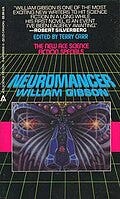
The film adaptation of Johnny Mnemonic introduced me to the cyberpunk world of William Gibson. After the movie came out, I found a book that had the short story and shooting screenplay, and I studied those obsessively. Then eventually came Neuromancer and the deeper architecture of Gibson’s work.
But here’s the important part:
Before those two sensibilities could fuse in my mind — the cold professionalism of Parker and the digital noir of Gibson — I had to spend time with Stark.
I had to absorb that influence.
Only then did the next one make sense.
This pattern reminds me of a principle from The Science of Getting Rich by Wallace D. Wattles.
Wattles wrote about the idea of filling your present place.
His argument was simple: when you fully use the resources available to you right now, life sends you the next set of resources required to move forward. Advancement doesn’t happen by skipping steps. It happens by completely inhabiting the space you’re standing in now.
The same thing happens in art.
Your influences arrive when you’re ready for them, but readiness means using what’s already in front of you.
Reading Stark deeply, then creating under that influence.
Then studying Gibson when he appears.
Then letting those worlds collide and meld in an organic way in my imagination.
Creative confidence grows from trusting that process.
You don’t need to see the entire lineage of your future influences today. This is where analysis paralysis comes from. The feeling of not being ready compels you to seek one more title, one more review, one more academic article, instead of just writing.
You only need to follow the thread that has caught your immediate attention.
If a character fascinates you, follow that character.
If a writer’s voice hooks you, study that voice.
If a strange connection appears between two seemingly unrelated worlds, explore it.
Give yourself permission to pursue your curiosity.
Pursue it fully, enthusiastically.
Because the next influence — the one that expands your creative range — arrives only after you’ve fully used the one that presently captures your imagination.
Happy 4th o July.
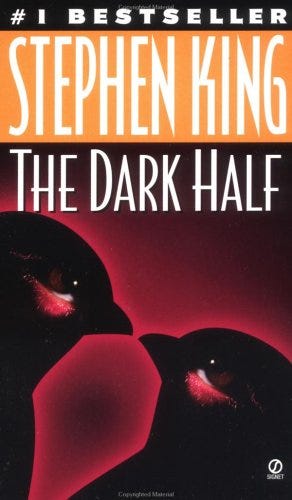
The Dark Half (1989) the book that started the chain of causality that led to Stark, and then to Gibson.
Payback (1999) the movie that brought me back to the thread I’d forgotten about that I found in The Dark Half
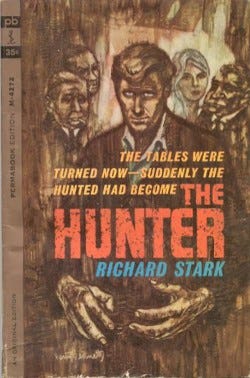
The Hunter (1962)The book came after the movie, and the loop of influence that started with the Dark Half was nearly complete
It's sad that you explore your curiosities more actively when you're younger, but slowly lose that practice as you get older.
I'm grateful that I have space in my life to explore the things that show up in the moment, but I also feel guilty when I do that because I'm not being productive.
But this article was a good reminder that it is valuable to be in the present and explore, so thank you for that.
I love the idea of following the thread that catches your attention. I think we underestimate how much our curiosity is trying to tell us. The things we return to are usually pointing toward something we’re trying to understand, even if we don’t know what that is yet.
Happy Monday Jay
How are you?